
English 


Views: 0 Author: Site Editor Publish Time: 2026-08-19 Origin: Site


Dry bulk packaging lines face a constant battle between filling speed and weight accuracy. Pushing a line to maximum throughput often causes erratic fill weights. If you prioritize absolute precision, production bottlenecks, leaving upstream equipment idle and downstream palletizers waiting. Overfilling—product giveaway—eats into material yield over high volumes. Giving away an extra five grams per bag seems minor on one cycle, but across millions of cycles, it drains sellable inventory. To decouple speed from accuracy, engineers use a two-stage feeding mechanism: coarse and fine feeding. This sequential setup forms the mechanical foundation of any modern granule filling machine. Splitting the dispensing cycle into a rapid bulk fill followed by a controlled dribble fill allows facilities to hit strict weight tolerances without dropping their target cycles per minute. We will look at how manipulating the transition between these stages optimizes line efficiency.
Two-Stage Synergy: Coarse feeding drives production speed by dispensing 80–90% of the target weight rapidly, while fine feeding ensures precision for the final 10–20%.
Material Dependency: The exact ratio and transition point between feeding stages must be calibrated based on granule size, bulk density, flowability, and material fragility.
Equipment Architecture: Throughput requirements dictate whether a single-head small batch granule weighing filler or a high-speed double head granule filler is required to optimize the coarse/fine cycle.
ROI Driver: Proper synchronization of these feeding stages directly minimizes product giveaway, paying for the equipment upgrade through recovered material costs.
The mechanical objective of coarse feeding is straightforward. You need to move the maximum volume of product from the supply hopper into the weigh bucket in the shortest time mathematically possible. This stage prioritizes sheer velocity over precision. During the bulk fill phase, the machine activates its primary delivery mechanisms at maximum capacity. Depending on the machine's architecture, this involves fully opening pneumatic gravity gates, driving vibratory pans at their highest amplitude, or spinning auger screws at maximum RPM.
Because the primary goal is speed, coarse feeding is inherently inaccurate. The sheer volume of material moving simultaneously creates significant momentum. Granules cascade rapidly, and a large portion of the material is in-flight between the feeding mechanism and the weigh bucket at any given millisecond. If the machine attempted to hit the final target weight using only the coarse feed, the accumulated weight of this in-flight material would cause massive overshooting once it finally landed in the bucket. The coarse feed must be intentionally cut off well before the final target weight is reached. Pneumatic cylinders driving these gates require consistent air pressure, typically around 80 PSI, to ensure the gate snaps shut instantly when the command is given, preventing trailing material from ruining the bulk phase.
Once the coarse feed terminates, the fine feeding stage immediately engages. The mechanical objective shifts entirely from speed to controlled, low-volume dispensing. You want to hit the exact target weight without overshooting. To achieve this, the machine restricts the flow of material drastically. Pneumatic gates close down to a narrow slit, vibratory pans drop to a very low amplitude, or augers slow to a crawl. In highly optimized systems, the fine feed attempts to drop material almost granule by granule using specialized V-shaped vibratory pans that align the product into a single-file stream.
During this critical phase, the load cell becomes the most important component of the machine. The load cell provides continuous, real-time feedback to the control system, measuring the accumulating mass with millisecond precision. Because the flow rate is restricted, the amount of in-flight material is minimized. This allows the load cell to accurately register the weight and signal the control system to shut the feeding gate the exact moment the target weight is achieved. High-end strain gauge load cells or electromagnetic force restoration scales are required here, as they offer the rapid settling times necessary to keep the cycle moving.
The transition point, often referred to as the switch-over weight, is the exact moment the machine stops the coarse feed and starts the fine feed. Setting this point requires a specific mathematical framework. Operators typically set the transition point between 85% and 95% of the total target weight. For example, if the target weight is 1000 grams, the coarse feed might be programmed to stop at 900 grams, leaving the final 100 grams for the fine feed.
The exact timing of the fine-feed shutoff is heavily impacted by in-flight material. Even during the slow dribble fill, a small amount of product is falling through the air when the gate receives the signal to close. If the target is 1000 grams, the system might actually command the gate to close at 996 grams. The remaining 4 grams represent the calculated in-flight material that will land in the bucket after the gate has fully shut. Accurately predicting this in-flight mass is essential for hitting the target weight consistently.
| Target Weight | Coarse Feed Cutoff (90%) | Fine Feed Target | Estimated In-Flight Offset | Actual Gate Close Command |
|---|---|---|---|---|
| 500g | 450g | 50g | 2g | 498g |
| 1000g | 900g | 100g | 4g | 996g |
| 5000g | 4500g | 500g | 15g | 4985g |
| 25000g | 22500g | 2500g | 45g | 24955g |
Modern programmable logic controllers (PLCs) and touchscreen human-machine interfaces (HMIs) manage coarse and fine feeding ratios. Operators no longer manually adjust mechanical linkages. They program specific coarse/fine ratios, vibration amplitudes, and gate opening percentages directly through the HMI. These parameters are saved as distinct product recipes, allowing for rapid changeovers between different materials or bag sizes. The PLC scan rate is critical here; a system scanning at 2 milliseconds will react much faster to load cell data than a system scanning at 10 milliseconds, directly impacting the accuracy of the gate closure.
Advanced control systems feature auto-tuning software that dynamically adjusts the transition point based on historical fill data. If the machine detects a trend of slight overfilling across ten consecutive cycles, the auto-tuning algorithm automatically lowers the fine-feed shutoff point by a fraction of a gram to compensate. This dynamic adjustment accounts for environmental changes, such as shifts in factory humidity or variations in the material's bulk density throughout a production run.
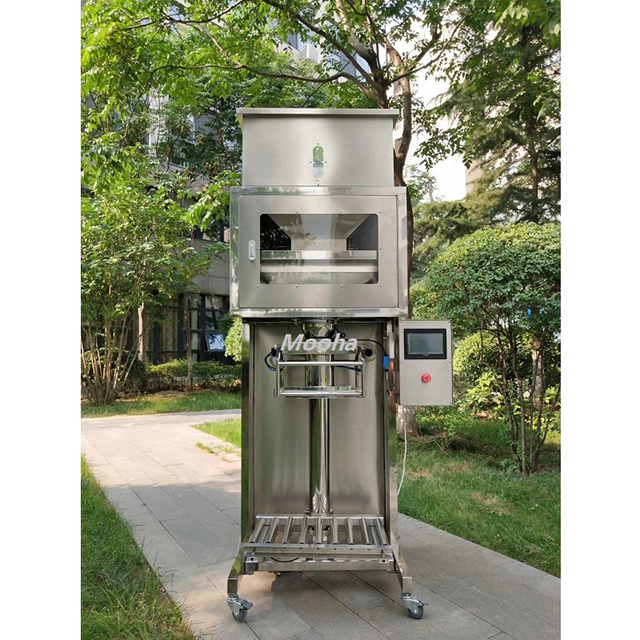
The physical characteristics of the product dictate how the coarse and fine feeding stages must be configured. Uniform, free-flowing materials like refined sugar, table salt, or plastic pellets behave predictably. They have a low angle of repose and flow through hoppers and gates with consistent velocity. Because their flow rates are stable, operators can push the transition point much later in the cycle. A free-flowing material might allow the coarse feed to run until 95% of the target weight is reached, requiring only a brief fine feed stage. This maximizes overall machine throughput.
Irregular or non-free-flowing granules behave unpredictably. Crushed stone, irregular snack foods, or sticky organic fertilizers tend to interlock. They do not flow smoothly; instead, they move in clumps or surges. If the coarse feed runs too long with these materials, a sudden surge could dump a massive clump into the weigh bucket, instantly overshooting the target weight. To prevent these sudden weight spikes, non-free-flowing materials require an earlier transition to fine feeding, often around the 80% or 85% mark. This provides the fine feed mechanism enough time to break up clumps and meter the product accurately.
Batch-to-batch density variations significantly impact volumetric flow versus actual weight. If a new batch of material is slightly denser than the previous one due to settling or aeration in the hopper, the same volumetric flow rate will result in a higher mass flow rate. The load cell will register the weight faster, requiring the control system to react more quickly. If the fine feed is not adjusted to account for this increased density, the machine will consistently overshoot the target.
Large particle sizes introduce a specific challenge known as the single piece overweight problem. If you are packaging large walnuts and the target weight is 500 grams, the final fine feed stage becomes mathematically difficult. If the bucket currently holds 490 grams, and a single walnut weighs 15 grams, dropping one more piece will result in a final weight of 505 grams. The machine is forced to either accept the 5-gram giveaway or reject the batch. Handling large particles requires specialized dribble gate designs that can separate individual pieces and prevent multiple large granules from dropping simultaneously.
| Material Type | Flow Characteristic | Ideal Coarse Feed Ratio | Primary Challenge |
|---|---|---|---|
| Refined Sugar / Salt | Highly Free-Flowing | 90% - 95% | Dust generation during high-speed bulk fill. |
| Plastic Pellets | Uniform Free-Flowing | 90% - 95% | Static electricity causing pellets to cling to gates. |
| Irregular Snacks | Interlocking / Surging | 80% - 85% | Clumping and sudden weight spikes. |
| Large Nuts / Beans | Non-Uniform | 80% - 85% | The single piece overweight mathematical limit. |
| Freeze-Dried Fruit | Fragile / Brittle | 75% - 80% | Product breakage from high-amplitude vibration. |
Aggressive coarse feeding mechanisms can severely damage brittle or delicate materials. High-speed vibratory pans or rapidly rotating augers exert mechanical stress on the product. When handling fragile goods like freeze-dried strawberries, roasted coffee beans, or delicate extruded snacks, running the coarse feed at maximum capacity will result in unacceptable levels of product breakage and dust generation. This degrades the final product quality and creates fine particulate matter that can foul the machine's pneumatic seals.
To preserve product integrity, operators must adjust the coarse/fine ratio specifically for fragile goods. This usually involves reducing the maximum speed or amplitude of the coarse feed, effectively turning it into a medium feed. The machine must rely more heavily on a gentler fine-feed stage. The transition point is often lowered to 75% or 80%, allowing the product to be metered slowly and carefully. Urethane-lined chutes and soft-close pneumatic gates are often installed to cushion the impact of the granules as they exit the fine feed stage. While this extends the overall cycle time, it is a necessary trade-off to maintain product quality and reduce waste.
Facilities operating in low-throughput, high-mix environments often rely on single-head configurations. A small batch granule weighing filler is designed for flexibility rather than absolute maximum speed. In these systems, the operational reality is strictly sequential. The single weigh bucket must receive the coarse feed, wait for the transition, receive the fine feed, wait for the load cell to stabilize, and then discharge the product. This sequential processing limits the maximum cycles per minute (CPM) the machine can achieve.
Despite the lower throughput, single-head systems offer distinct advantages for specific operational models. Facilities running multiple small batches per shift require equipment that can be cleaned and reconfigured rapidly. Single-head machines typically feature tool-less changeovers, quick-release hoppers, and accessible product pathways. They often carry high washdown ratings (like IP65), allowing operators to switch from packaging coffee beans to packaging rice in a matter of minutes, minimizing costly downtime between production runs.
When production demands scale up, the sequential limitations of a single-head system become a severe bottleneck. To overcome this, facilities upgrade to multi-head or double-head architectures. A double head granule filler provides a massive parallel processing advantage. While one weigh bucket is slowly executing the fine dribble feed to achieve perfect accuracy, the second weigh bucket is simultaneously executing the rapid coarse feed for the next batch.
This overlapping sequence effectively doubles the machine's throughput without sacrificing the accuracy of the fine feeding phase. The control system synchronizes the discharge of the buckets, ensuring a continuous flow of accurately weighed product to the downstream bagging or canning equipment. The PLC must handle overlapping commands, ensuring that the vibration from bucket A's coarse feed does not interfere with the load cell reading of bucket B's fine feed. While double-head systems require a larger physical footprint and represent a higher initial capital expenditure, the drastic increase in CPM makes them essential for high-volume, dedicated packaging lines where maximizing output is the primary objective.
| Feature | Single Head System | Double Head System |
|---|---|---|
| Processing Method | Strictly Sequential | Parallel / Overlapping |
| Typical Throughput | 10 - 20 CPM | 25 - 50 CPM |
| Footprint | Compact | Large |
| Changeover Time | Fast (Under 15 mins) | Moderate (20 - 40 mins) |
| Ideal Application | High-mix, low-volume runs | Dedicated, high-volume lines |
The most critical metric for evaluating the success of a coarse and fine feeding setup is the reduction of product giveaway. Establishing a framework for calculating acceptable giveaway tolerances is the first step. Operating with a +/- 5g tolerance on a 500g bag might be acceptable for low-value commodities like gravel, but it is financially disastrous for high-value products like specialty coffee or pharmaceutical precursors. For high-value goods, the tolerance must be tightened to +/- 1g or less.
Optimizing the fine feed stage directly reduces the standard deviation in fill weights. By fine-tuning the dribble gate and accurately calculating in-flight material, operators can shift the average fill weight closer to the stated label weight without risking under-filled bags. If a facility producing 10,000 bags a day reduces its average giveaway from 4 grams to 1 gram per bag, it saves 30 kilograms of product daily. Over a fiscal year, this recovered material directly impacts the bottom line, paying for the equipment upgrade entirely through material yield improvements.
Balancing accuracy with speed requires understanding the law of diminishing returns as it applies to the fine feed stage. Extending the fine feed duration will almost always improve weight accuracy, but it exponentially increases the total cycle time. If the fine feed is set to drop one granule per second to achieve absolute perfection, the machine's throughput will plummet, causing downstream packaging equipment to starve for product.
Establishing a baseline acceptable cycle time requires analyzing the entire production line. The filling machine should not operate faster than the downstream sealer can close the bags, nor should it operate slower than the upstream mixer can supply the product. The coarse/fine ratio must be calibrated to hit the exact CPM required to keep the entire line synchronized. Using accumulation conveyors between the filler and the sealer can provide a buffer, but the baseline CPM must remain consistent. Once that target CPM is achieved, operators can then tighten the fine feed parameters to maximize accuracy within that specific time window.
A perfectly calibrated feeding system is useless if it cannot maintain that calibration throughout a long production shift. Continuous high-amplitude vibrations from the coarse feeding stage transmit mechanical stress throughout the machine's frame. Over hours of operation, this vibration can cause mechanical loosening of gate linkages or induce load cell drift, where the scale's zero-point slowly shifts due to temperature changes or mechanical creep.
Evaluating machines requires looking at their long-term stability features. Robust, vibration-resistant load cell mounts are critical for isolating the sensitive weighing components from the aggressive coarse feed mechanisms. The control system must include an auto-tare function. This feature automatically resets the scale to zero after every discharge cycle, compensating for any residual dust left in the bucket and neutralizing any minor load cell drift before it impacts the next batch.
One of the primary risks in two-stage feeding systems is mechanical noise interfering with the weighing process. Vibratory feeders are highly effective for moving granules, but they generate significant mechanical vibration. If this vibration transmits through the machine frame into the load cell, the scale will read erratic, fluctuating weights. This prevents the control system from accurately identifying the transition point or the final shutoff weight, leading to massive inconsistencies.
Mitigating this risk requires a multi-tiered approach. Mechanically, the load cells must be mounted on independent structures or isolated using heavy-duty dampeners to block vibration transfer. Electronically, the control system must utilize advanced digital signal processing (DSP) filters. These algorithms sample the load cell data hundreds of times per second and filter out the specific frequency of the vibratory feeder, allowing the PLC to read the true mass of the product even while the machine is shaking.
A perfectly programmed weighing filling machine will still fail if the product does not flow consistently from the supply hopper. Material bridging or rat-holing occurs when granules interlock and form an arch over the discharge opening. This starves the coarse feed mechanism. When the coarse feed fails to deliver the expected volume, the machine is forced to rely entirely on the slow fine feed to reach the target weight, destroying the cycle time.
To mitigate inconsistent flow, the hopper design must match the material characteristics. You can implement several mechanical solutions to prevent bridging:
Integrate slow-rotating mechanical agitators inside the hopper to physically break up interlocking granules before they reach the throat.
Install pneumatic air pads along the lower third of the hopper to fluidize the material and reduce friction against the steel walls.
Specify a hopper with a steep 60-degree cone angle or asymmetrical vertical walls to promote mass flow rather than funnel flow.
Mount external pneumatic vibrators directly to the hopper exterior to keep sticky materials moving toward the coarse feed gates.
Pull a 50-pound sample of your most difficult material and run a physical flow test to determine its angle of repose and bridging tendencies.
Calculate your current daily product giveaway in grams to establish a baseline for acceptable load cell accuracy and justify equipment upgrades.
Audit your downstream packaging equipment to find the maximum bags-per-minute rate, using this hard limit to set your coarse and fine cycle times.
Specify independent, vibration-isolated load cell mounts and DSP filtering when drafting the equipment purchase order.
A: Volumetric machines fill by space, causing weight variations if bulk density changes. Weighing filling machines measure actual mass using load cells. They utilize coarse and fine feeding stages to dynamically adjust to density shifts, ensuring the final bag always contains the exact target weight regardless of volumetric changes.
A: The transition point is calculated by taking the final target weight and subtracting the estimated mass of the in-flight material, then subtracting the volume required for the fine feed to stabilize. Operators typically set the coarse feed to stop at 85% to 95% of the total target weight.
A: Overshooting usually occurs for two reasons. The coarse feed transition point is set too high, leaving insufficient time for the fine feed to meter the product. Alternatively, the fine feed rate itself is too fast for the load cell to register the accumulating weight in time.
A: Delicate materials cannot withstand aggressive bulk filling. High-speed vibration or fast auger rotation will crush fragile goods and generate dust. Operators must lower the speed of the coarse feed and transition to the gentle fine feed much earlier in the cycle to prevent product breakage.
A: Generally, no. Powders require sealed auger systems to force non-free-flowing dust through the machine without leaking. Granules require gravity gates or vibratory pans to prevent crushing the particles. Using the wrong feeding mechanism will result in severe inaccuracies, dust clouds, or machine jamming.
A: A double head system allows for parallel processing. While one weigh bucket is slowly performing the fine dribble feed to ensure perfect accuracy, the second bucket is simultaneously executing the rapid coarse feed for the next cycle. This overlapping sequence drastically increases overall machine throughput.

