
English 


Views: 0 Author: Site Editor Publish Time: 2026-03-12 Origin: Site


Not every small container requires complex automation, so where does a vial filling machine truly make sense? Many businesses package liquids or powders in compact formats but are unsure whether this type of equipment fits their production model. Understanding the real application scenarios is essential before making a decision. This article explains what a vial filling machine is used for, which products benefit most from it, and how different industries apply it in daily production.
Small-dose products often carry high value. Whether the product is a laboratory reagent, pharmaceutical liquid, premium cosmetic sample, or specialty extract, the quantity per unit is limited. In such cases, dosing accuracy directly affects both cost control and customer trust.
Manual filling may appear sufficient at first, but small volumes magnify even minor inconsistencies. Overfilling wastes valuable product, while underfilling damages brand credibility. A vial filling machine ensures precise, repeatable dosing that protects product value and improves presentation consistency.
This is especially important when companies are producing premium or compliance-oriented items where documentation and reliability matter as much as the physical product itself.
For many applications, sealing is just as important as accurate dosing. Leakage, evaporation, or contamination can quickly reduce product effectiveness.
Perfume samples must retain fragrance strength. Biotech fluids must remain uncontaminated. Pharmaceutical-style liquids must maintain sterility and stability. In these cases, the integration of filling and closure into a controlled workflow becomes critical.
An integrated vial filling capping machine minimizes product exposure between stages and supports consistent sealing performance, which helps preserve product integrity during storage and transportation.
One of the most common uses of a vial filling machine is for small-volume liquids. These may include:
Perfume samples
Air freshener liquids
Oral liquid supplements
Research reagents
Biotech fluids
Specialty chemical solutions
These products typically fall within the 10–100 ml range, making them ideal for vial packaging. Because small containers demand precise fill control, automated dosing improves both quality and efficiency.
For cosmetic brands producing trial-sized products or promotional packaging, consistent fill levels enhance shelf appearance and customer perception. For laboratories, accurate dosing supports reliable testing procedures.
Although often associated with liquids, vial systems can also be used for fine powder applications. In certain industries, small measured quantities of food additives, chemical powders, or agricultural samples are packaged in vial formats.
Powder handling requires specialized dosing principles. Unlike free-flowing liquids, powders may vary in density and flow behavior. Auger-based or calibrated dosing systems are typically used to achieve stable volume control.
For food, chemical, or agricultural powder packaging in small containers, a properly configured vial filling system can deliver consistent weight control and cleaner handling compared to manual processes.
Some buyers search for a penicillin filling machine, which generally refers to a vial-based filling system designed for pharmaceutical liquids. While the core function remains the same—accurate filling and secure closure—the configuration may emphasize hygienic design and reliable sealing.
These applications require stainless steel construction, easy cleaning surfaces, and stable stoppering and capping operations. Rather than representing a separate equipment category, this is a specialized use case within the broader scope of vial filling systems.
In pharmaceutical and biotech production, sterility and precision are top priorities. Small-dose medications, injectable solutions, laboratory reagents, and cell-related fluids must be handled carefully.
A vial filling machine supports controlled dosing, stable stoppering, and secure sealing. Integrated systems reduce unnecessary handling and help maintain a cleaner production environment.
Cosmetic companies frequently package sample perfumes, serums, essential oils, and promotional liquids in small vials. Presentation consistency is critical for brand reputation.
Leak-proof sealing ensures that fragrances and active ingredients remain intact during shipping. Automated filling also helps maintain uniform appearance across large batches.
For this sector, the ability to adjust fill volume and accommodate different vial sizes supports product diversification.
Small-dose flavorings, extracts, or specialty food ingredients may also be packaged in vial formats for testing, sampling, or premium retail products.
Accurate fill control ensures consistent flavor strength. Clean sealing prevents leakage and protects the product during storage.
Chemical reagents and specialty test liquids often require small-container packaging. Consistent dosing improves measurement reliability, while secure sealing reduces contamination risk.
In these environments, repeatability and controlled handling are essential.
Suitability depends on product characteristics and packaging format. If the product is packaged in small containers requiring accurate measured amounts, a vial filling system can be appropriate.
The machine must be configured for the specific powder’s density and flow properties. Stable feeding and calibrated dosing mechanisms ensure uniform output.
Powders behave differently from liquids. They may compress, settle, or resist flow. For this reason, auger fillers or other volumetric dosing systems are often integrated into powder-oriented setups.
Shanghai Mooha’s broader experience in powder filling lines, granule filling lines, and liquid packaging systems strengthens its ability to configure appropriate dosing solutions for different materials. This versatility supports businesses working with both liquids and powders in small container formats.
The central point remains clear: a vial filling machine is used wherever small-dose packaging requires accurate dosing and reliable sealing. Whether the material is liquid or powder, the defining factor is controlled small-volume packaging rather than bulk production.
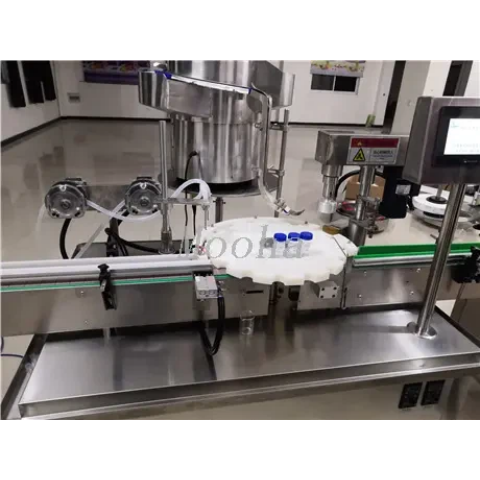
Certain liquid products, including specialty formulations sometimes described under the keyword e-liquid vial filling machine, require stable fill levels and tight sealing.
Small bottles with narrow openings must be handled carefully to prevent spills and leakage. Consistent dosing ensures that each unit meets quality expectations.
An integrated filling and capping structure supports repeatable daily production without excessive manual intervention.
Secure capping reduces the risk of leakage during shipping. It also improves the finished appearance of the product on retail shelves.
For cosmetic or specialty liquid products, visual consistency enhances brand credibility. Uniform cap positioning and fill height create a professional impression.
Integrated workflow reduces alignment errors between filling and closure stages, contributing to smoother production and more reliable output.
Manual processes require more direct contact between operators and products. This increases contamination risk and slows production.
Automated systems guide vials through a controlled sequence, reducing unnecessary exposure and improving hygiene conditions.
Human-operated filling often produces variation in fill level and cap tightness. Automation ensures repeatable motion and stable dosing, resulting in uniform finished products.
Consistency strengthens brand image and reduces quality complaints.
As demand grows, manual methods become inefficient. Automated vial filling systems allow businesses to increase output without significantly expanding labor requirements.
Scalable design supports gradual growth from pilot batches to routine commercial production.
Product Type | Typical Use Scenario | Why a Vial Filling Machine Helps | Relevant Keyword Angle |
Perfume / fragrance samples | Small retail or promo packs | Precise dosing and leak-resistant capping | vial filling machine |
Reagents / lab liquids | Sensitive small-volume packaging | Cleaner, more accurate filling | vial filling capping machine |
E-liquid / specialty liquids | Small bottles needing stable fill | Repeatable dosing and secure closure | e-liquid vial filling machine |
Pharmaceutical-style liquids | Controlled-dose filling | Better hygiene and process control | penicillin filling machine |
Fine powders | Small measured doses | More consistent dosing with suitable setup | vial filling machine |
This overview demonstrates that application scenarios vary widely, yet the core requirement remains consistent: accurate small-volume filling combined with reliable sealing.
Shanghai Mooha integrates research, production, and sales of filling and packaging machinery. Its experience spans liquid packaging, powder packaging, granule filling lines, labeling, and sealing systems.
This broad technical foundation supports diverse vial applications across pharmaceutical, cosmetic, biotech, food, and chemical sectors. Instead of limiting the system to one industry, the configuration can be adjusted to suit different product characteristics.
Different products require different parameters. Vial size, liquid viscosity, powder density, and production speed all influence machine configuration.
Mooha emphasizes adjustable filling volume, compatibility with various vial materials, and adaptable speed settings. This approach allows businesses to tailor the system to their own packaging needs rather than adapting their products to a rigid machine structure.
Integrated filling and capping reduces product exposure and streamlines workflow. Stainless steel construction and easy-to-clean components support hygienic operation.
This design philosophy aligns with industries where product safety and consistency are essential.
A vial packaging system is used wherever small-dose liquids or powders require cleaner, more accurate, and more reliable filling combined with secure closure. From perfume samples to laboratory reagents and pharmaceutical-style applications, this equipment supports controlled small-volume production across multiple industries. If your business handles sensitive products in compact formats, contact Mooha to explore how a customized integrated solution can improve efficiency and packaging consistency.
A vial filling machine can handle small-volume liquids such as perfumes, reagents, and oral solutions, as well as certain fine powders when configured appropriately.
The term usually refers to a pharmaceutical-oriented configuration emphasizing hygiene and reliable sealing. It remains a type of vial filling system designed for medical-style applications.
Yes, if the packaging format involves small, controlled doses and the machine is configured with suitable powder dosing mechanisms.
Automation improves dosing accuracy, enhances sealing consistency, reduces contamination risk, and supports scalable production growth.

