
English 


Views: 0 Author: Site Editor Publish Time: 2026-08-13 Origin: Site


Production facilities constantly balance high throughput demands with mandatory sanitation requirements. Changeover downtime and product waste during purging remain the largest hidden drains on dry packaging lines. Every product switch introduces cross-contamination risks, including allergen transfer, flavor ghosting, and active pharmaceutical ingredient carryover. Lengthy cleaning cycles eat directly into production schedules. Residual buildup on the rotating screw degrades volumetric filling accuracy. A dirty machine inherently gives away product or under-fills containers. Evaluating mechanical cleanability is a major procurement decision. Toolless disassembly, robust washdown capabilities, and advanced closure methods dictate Overall Equipment Effectiveness (OEE) and product yield. Prioritizing sanitary design transforms a multi-hour teardown into a predictable, rapid process. This protects product integrity and keeps the line moving.
Toolless Disassembly is Baseline: Modern auger fillers must feature quick-release mechanisms for hoppers, augers, and agitators to keep changeover times under 30 minutes and ensure food safety.
Cutoff Devices Impact Sanitation and Savings: Positive cutoff mechanisms and advanced closure methods not only prevent product drip and aeration issues but also dictate how easily the tooling can be purged, directly reducing product waste.
Washdown vs. Dry Cleaning: The choice between dry wipe-downs and wet washdowns depends on product characteristics (e.g., allergens, cohesive powders vs. free-flowing granules) and requires specific machine IP ratings.
Configuration Complexity: Multi-lane setups, such as a double head powder bottle filler, exponentially increase cleaning complexity compared to single-head systems, requiring standardized, verifiable SOPs.
Volumetric Precision Relies on Cleanliness: Consistent volumetric dosing requires pristine auger flights; even minor product degradation or caking alters the volume dispensed per revolution.
A successful product changeover requires meeting strict criteria within a scheduled downtime window. You must achieve zero cross-contamination, pass verifiable swab tests, and minimize product loss during the purge phase. Operators need clear, repeatable steps that do not rely on specialized mechanical skills. When a changeover drags past its allotted time, the entire packaging line sits idle. Defining success means measuring the exact minutes from the last acceptable fill of Product A to the first acceptable fill of Product B. Every minute saved directly increases available production capacity.
Plant managers track changeover efficiency through a rigid sequence of events. The standard procedure involves several distinct phases that dictate the total downtime. If any single phase encounters a delay, the entire line suffers.
Lockout/Tagout (LOTO): Securing the machine from electrical and pneumatic power sources.
Dry Purging: Evacuating the bulk of the remaining product from the hopper into recovery bins.
Teardown: Removing the hopper lid, agitator blade, auger screw, and discharge funnel.
Sanitation: Executing either a dry wipe-down or a full wet washdown with chemical foaming.
QA Validation: Performing ATP or specific allergen swab testing on product-contact surfaces.
Reassembly and Calibration: Reinstalling the tooling, restoring power, and running test weights.
Improper cleaning introduces severe regulatory and safety liabilities. Facilities processing food must comply with FDA and FSMA allergen controls. Trace amounts of peanut or dairy powder can trigger massive recalls. Pharmaceutical plants operate under strict cGMP standards, where active ingredient carryover compromises patient safety. Powders easily become airborne and settle on hidden machine surfaces. If your cleaning protocol fails to address these hidden accumulation zones, you risk contaminating subsequent batches. Regulatory auditors specifically look for validated cleaning procedures that eliminate these risks entirely.
Airborne dust presents a secondary contamination vector. When operators aggressively blow down a machine with compressed air, they simply relocate the dust to overhead pipes, conveyor rails, and adjacent equipment. This dust eventually falls back into open containers. Effective sanitation requires vacuuming and controlled wiping, never uncontrolled compressed air.
Inefficient purging protocols waste high-value powders. When operators flush a machine to clear the previous product, they often discard pounds of usable material. Powders that cling to the hopper walls or pack tightly into the auger flights require extensive manual scraping if the machine lacks proper sanitary design. Advanced machines allow you to recover more product before the actual cleaning begins, preserving your yield and reducing the volume of material sent to the waste bin.
Consider the physical properties of cohesive materials like whey protein isolate or titanium dioxide. These powders bridge across the lower funnel. This bridging forces sanitation crews to use plastic scrapers to physically dislodge the packed material. Every ounce of powder scraped into a waste barrel represents lost revenue. A highly polished stainless steel interior reduces this clinging effect, allowing more product to flow out during the initial purge.
Evaluating the financial impact of changeover delays requires looking at a full fiscal year. Consider a facility running two shifts, performing one changeover daily. A traditional machine taking two hours to clean consumes 500 production hours annually. A sanitary design machine taking 30 minutes reclaims 375 hours of active production time. You must factor in the hourly labor rate of the sanitation crew, the lost revenue from unproduced units, and the cost of wasted powder.
| Metric | Legacy Equipment (2-Hour Changeover) | Sanitary Design Equipment (30-Min Changeover) | Annual Impact (250 Changeovers) |
|---|---|---|---|
| Downtime per Changeover | 120 minutes | 30 minutes | Save 375 production hours |
| Labor Allocation | 2 operators required | 1 operator required | Reduce labor hours by 87.5% |
| Product Waste per Purge | 5 lbs | 1 lb | Save 1,000 lbs of product |
| Swab Test Pass Rate | Variable (often requires re-cleaning) | Highly consistent | Eliminate secondary downtime |
Traditional solid hoppers force operators to reach blindly into confined spaces to scrape out residual powder. This design creates ergonomic hazards and virtually guarantees missed accumulation spots. Split-hopper, or half-shell, designs solve this problem. A split hopper opens completely, exposing the entire interior, the auger, and the agitator blade. Operators can visually inspect the surfaces and clean them without confined-space restrictions. This accessibility is vital for cohesive products like flour or baking powder, which tend to bridge and pack against the hopper walls. When evaluating an auger powder filler, a split hopper is a non-negotiable feature for fast sanitation.
The interior finish of the hopper also dictates cleanability. Standard mill-finish stainless steel contains microscopic pits and grooves that trap fine particulates. Sanitary machines utilize polished interiors, often specified to a 32 Ra (Roughness Average) or better. This mirror-like finish prevents powder from adhering to the sidewalls, allowing dry wipes to remove residue without heavy scrubbing.
The method used to secure the auger and agitator dictates your teardown speed. Threaded connections pose significant risks. Fine powders work their way into the threads, causing the components to seize up. Threads also harbor bacteria and are notoriously difficult to swab clean. Operators often resort to using heavy wrenches to break loose seized threads, which damages the stainless steel and creates metal shavings.
Modern sanitary designs utilize quick-disconnect couplings, such as sanitary tri-clamp or bayonet-style fittings. These mechanisms allow operators to release the heavy stainless steel tooling in seconds using no tools. Fast disassembly means the tooling can be moved to a dedicated wash station immediately. You eliminate the need for tool carts and prevent the mechanical damage associated with wrench slips.
Closure methods at the bottom of the funnel heavily influence both filling accuracy and cleanability. Positive cutoff devices, clamshell closures, and spinner plates serve to stop product flow instantly. Sealing off the auger between fills prevents aerated product from leaking onto the conveyor or the exterior of the containers. A clean cutoff reduces exterior machine contamination, meaning operators spend less time wiping down the machine frame and surrounding floor.
Advanced cutoff devices contain the product during the initial purge cycle. This allows for controlled evacuation of the hopper and significantly reduces airborne dust during teardown. When the cutoff remains closed, operators can attach a vacuum shroud directly to the discharge point, capturing the dust before it enters the packaging room atmosphere.
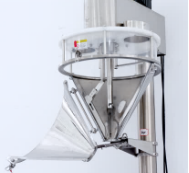
Scaling up production often means moving from a single-head system to a multi-lane configuration. You must evaluate the trade-off between higher throughput and increased changeover time. A double head powder bottle filler doubles the amount of tooling that requires cleaning. Dual-head systems demand synchronized cleaning SOPs to ensure both dosing stations meet validation standards simultaneously. If one head fails a swab test, the entire machine remains offline.
Operators must remove, clean, and re-install two sets of augers, funnels, and agitators without mixing up the matched components. Standardizing the cleaning cart layout and using color-coded tooling helps prevent reassembly errors. You must assign dedicated sanitation personnel to each head to run the cleaning processes in parallel, rather than sequentially, to keep downtime manageable.
Enclosed systems present unique sanitation challenges compared to open-mouth filling setups. A valve bag powder filler operates in a dust-tight environment, injecting product directly into a closed bag through a spout. Cleaning these systems requires specific internal purging routines. You must clear residual product from the delivery spout, the internal inflatable seals, and the dust extraction pathways.
Dust collection systems integrated into valve baggers often harbor fine particulates. These particulates can drift back into the primary product stream if not properly isolated and cleaned during a changeover. Operators need clear access to the spout internals. Many modern valve baggers feature swing-away spouts that expose the internal delivery tube for direct vacuuming and swabbing.
Different dosing technologies require different cleaning approaches. Auger systems need meticulous cleaning because cohesive or high-fat powders cling tightly to the screw flights and the agitator arms. The geometry of the auger presents multiple surfaces where product can hide. The underside of the flights and the junction where the shaft meets the agitator blade require focused attention.
Cup fillers use volumetric cavities. They are generally simpler to wipe down but lack the precision required for non-free-flowing powders. When running free-flowing products like ground coffee, the tooling requirements change for both machine types. Auger systems may require specialized spinner plates that need careful disassembly. Cup fillers require thorough cleaning of the telescopic cup mechanisms to ensure no granules interfere with the volume adjustments.
Your product characteristics dictate your cleaning method. You must establish strict SOPs for either dry or wet sanitation. Mixing these methods improperly leads to severe equipment damage and biological growth.
Dry Cleaning: Best for non-allergenic, moisture-sensitive powders. Introducing water to hygroscopic powders creates a concrete-like sludge that is nearly impossible to remove. Dry cleaning involves heavy vacuuming, purging the system with inert materials like coarse salt or granulated sugar to scour the auger flights, and finishing with dry microfiber wiping.
Wet Washdown: Processing allergens, high-fat powders, or sticky particulates requires a full wet washdown with chemical sanitizers. The machine must be built for this abuse. You need NEMA 4X, IP65, or IP69K rated enclosures to protect servomotors, sensors, and PLCs from high-pressure water ingress.
Foaming and Scrubbing: Operators apply an alkaline foam to break down fats and proteins. The foam must sit for a specified contact time before manual scrubbing begins.
Rinsing and Drying: High-volume, low-pressure rinsing removes the foam. The equipment must be completely dried using forced air and clean towels before reassembly to prevent bacterial growth and flash rusting.
| Parameter | Dry Cleaning Protocol | Wet Washdown Protocol |
|---|---|---|
| Target Products | Spices, cement, talc, hygroscopic powders | Dairy powders, allergens, high-fat mixes |
| Primary Tools | HEPA vacuums, microfiber cloths, plastic scrapers | Foamers, hoses, chemical sanitizers, brushes |
| Machine Requirements | Standard dust-tight enclosures (IP54) | Washdown-rated enclosures (IP65/IP69K) |
| Validation Method | Visual inspection, dry swabs | ATP swabbing, specific allergen testing |
Highly aerated powders behave unpredictably during the purge cycle. They fluidize and flow like water, making them difficult to control as the hopper empties. Product degradation creates ultra-fine dust that complicates cleaning. The mechanical action of the auger breaks down particle sizes if the machine runs empty for too long.
You must safely evacuate these materials without creating a combustible dust hazard. Connect dedicated vacuum systems to the discharge point during purging. Slow down the agitator speed during the final empty phase to prevent whipping the remaining powder into an airborne cloud. Controlling the dust at the source drastically reduces the time spent cleaning the exterior machine frame and the packaging room walls.
A machine is not clean until validation proves it. Industry-standard methods verify that the equipment is safe for the next product run. ATP (Adenosine Triphosphate) swabbing detects biological residues, providing rapid feedback on surface cleanliness. Specific allergen testing targets proteins like gluten, soy, or dairy to ensure zero cross-contact.
Operators must swab the hardest-to-reach areas. Focus on the underside of the agitator blade, the inner lip of the discharge funnel, and the mating surfaces of the quick-disconnect fittings. Passing these tests ensures both consumer safety and the volumetric accuracy of the next batch. Pristine tooling guarantees consistent product displacement per revolution.
Stainless steel augers and funnels are precision-machined components. Dropping an auger on a concrete floor can bend the shaft or burr the flights. Scoring the inside of the hopper with a metal scraper creates microscopic scratches where bacteria and powder can hide. You must mitigate these risks through rigorous operator training.
Implement dedicated handling SOPs. Require operators to use custom tooling carts designed to cradle the augers and funnels during transport to the washroom. Ban the use of metal tools for scraping. Supply food-grade plastic or silicone spatulas instead. Treat the tooling like high-value assets, not rough metal parts.
Improper reassembly destroys tooling and causes immediate downtime. If an operator installs the auger slightly off-center, the metal flights will rub against the inside of the funnel during operation. This metal-on-metal contact generates heat, introduces metal shavings into the product, and destroys the tooling.
Modern machines mitigate this risk by utilizing self-aligning components and keyed shafts that only fit together one way. Eliminate the need for operators to guess torque specifications by using toolless clamps that lock into place with a definitive, tactile click. Error-proofing the reassembly phase guarantees a fast, safe startup.
Buyers frequently face the decision of whether to retrofit aging equipment or invest in a new system. Retrofitting an old machine with an upgraded cutoff device or attempting to cut a solid hopper into a split design often yields marginal improvements. Legacy frames usually lack the necessary IP ratings for proper washdowns, and their control cabinets cannot withstand moisture.
If your primary bottleneck is changeover time due to allergen protocols, investing in a new, sanitary-design Powder Filling Machine provides a much faster return on investment. Reserve retrofits for machines running dedicated product lines where changeovers are rare and dry wipe-downs suffice.
Take the following steps to optimize your powder filling operations:
Audit your current changeover times, documenting the exact minutes spent on teardown, cleaning, and reassembly.
Identify your most stringent cleaning requirement, such as specific allergen protocols or wet washdown necessities.
Calculate your annual product waste generated purely from the purging process between batches.
Contact an applications engineer to evaluate your current tooling and discuss sanitary design upgrades.
A: Modern, toolless auger fillers can typically be disassembled, dry-cleaned, and reassembled in 30 to 45 minutes. If your product requires a full wet washdown with chemical sanitizers and drying time, the process may take 1 to 2 hours. Legacy machines with threaded components and solid hoppers often take significantly longer.
A: It depends entirely on the machine's IP rating and construction. Sanitary stainless steel machines featuring IP65 or IP69K rated enclosures are specifically designed to withstand high-pressure wet washdowns. Standard machines without these ratings will suffer severe electrical damage if exposed to water.
A: A positive cutoff device is a mechanical closure method located at the bottom of the funnel. It seals the auger completely between fills. This prevents aerated product from dripping, reduces product waste, and minimizes the amount of exterior machine cleaning required.
A: Auger fillers dispense a specific volume of product per revolution. If caked powder builds up on the rotating screw or inside the funnel, it alters the available geometry. This changes the volume of product dispensed per revolution, leading to inaccurate fills and costly product giveaway.
A: Prevention requires independent tooling removal and strict, synchronized SOPs. Operators must perform verifiable swab testing on each dosing head individually. For highly allergenic products, facilities often utilize dedicated sets of augers and funnels for specific flavors or allergens to eliminate cross-contact risks entirely.
A: Valve bag fillers are enclosed, dust-tight systems that require specific internal purging routines to clear the delivery spout and inflatable seals. Open-mouth systems are generally more accessible. Valve baggers also require careful cleaning of integrated dust extraction pathways to prevent hidden product from drifting back into the main line.
A: Aerated and degraded powders become highly fluidized and prone to drifting. They easily settle on exterior machine components, walls, and floors. Managing them requires robust dust extraction and positive cutoff devices to contain the fine particulates during both normal operation and the purging phase.

