
English 


Views: 0 Author: Site Editor Publish Time: 2026-11-23 Origin: Site


Achieving the perfect fill weight for powdered products remains a critical manufacturing hurdle today. Even a slight overfill wastes valuable material over long production runs. This slowly eats away at your profit margins. Conversely, a consistent underfill severely damages brand trust and invites regulatory scrutiny. The powder filling machine acts as the backbone of modern packaging lines. Specifically, auger-driven systems dominate the market for handling complex particulates. These units operate strictly on a volumetric principle. How exactly do auger revolutions dictate this volume? The answer is crucial. The dispensed volume ultimately determines the final package weight. Mastering this mechanical relationship ensures high accuracy and operational efficiency. In this guide, we dive into the engineering behind auger turns, examine factors skewing accuracy, and provide practical calibration steps for the shop floor.
Volumetric Principle: Auger revolutions control the dispensed volume rather than the actual weight. One full rotation dispenses a precise and fixed physical space of powder.
Density is Crucial: The final fill weight relies heavily on the bulk density of the powder. Weight equals dispensed volume multiplied by this specific density.
Consistent Flow Matters: Fluctuations in powder flowability, moisture levels, or hopper capacities can quickly alter the bulk density. This causes weight variations even with constant auger revolutions.
Machine Selection: Choosing the right equipment depends largely on your production scale, container type, and material characteristics.
Calibration is Key: Regular testing and empirical calibration ensure that the motor RPM and revolution count accurately match your target fill weight.
An auger dispensing unit is highly efficient industrial packaging equipment designed to output precise amounts of dry products. Recognized as the most prevalent mechanism within the broader category of powder dispensing equipment, it is heavily utilized across the pharmaceutical, food and beverage, chemical, and cosmetic industries. Unlike liquid fillers that rely on gravity or pumps, these machines are specifically engineered to manage solid particulates. Solid powders behave unpredictably due to friction, aeration, and clumping.
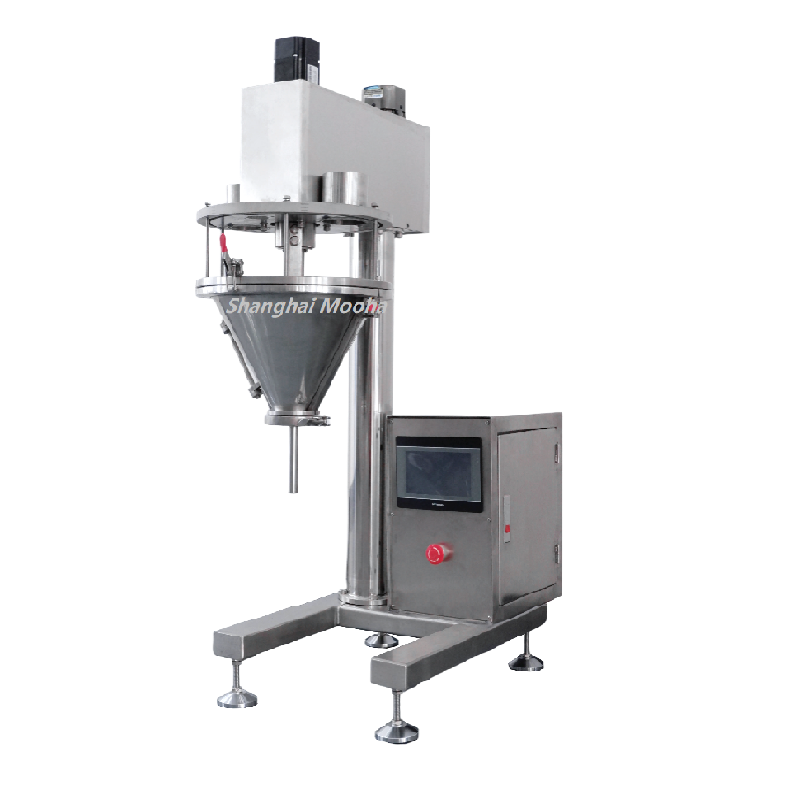
To understand how revolutions affect weight, one must first visualize the mechanical environment. An auger system relies on three primary components working in tandem. First, the hopper acts as a conical or V-shaped reservoir where the bulk powder is held prior to dispensing. It maintains the crucial head pressure of the material. Inside, an agitator blade rotates independently to stir the powder. This constant mechanical stirring prevents bridging and rat-holing. Furthermore, it ensures the powder is evenly fed into the dispensing mechanism with a consistent density. Finally, the auger screw pushes the powdered product downward into the waiting container. This screw is a vertically oriented, spiral-threaded shaft driven by a servo motor.
The fundamental operation of this machine is strictly volumetric. As the servo motor turns the auger screw at a set speed, the spiral flights capture the powder and carry it downward through a funnel. The control system, usually a Programmable Logic Controller, counts the exact number of mechanical revolutions. Because modern servo motors are incredibly precise, they can also measure exact fractions of a single revolution. Consequently, this precise counting dispenses the exact required product volume, eliminating human error from the complex packaging equation.
The relationship between the mechanical movement of the machine and the final mass of the packaged product is governed by a straightforward mathematical principle. Fill Weight equals the Volume per Revolution multiplied by the Number of Revolutions. That total calculated volume is then multiplied by the Bulk Density. In this equation, the machine only directly controls one single variable. That variable is the number of revolutions.
The pitch and outer diameter of the auger screw are vital physical dimensions. They determine the exact volume held in one single flight, which represents a complete 360-degree mechanical screw turn. For instance, if the physical geometry of the auger screw creates a cavity that holds exactly 10 cubic centimeters of volume, then one revolution will displace 10 cubic centimeters of powder. Therefore, if the control system commands the servo motor to execute exactly 10 revolutions, the machine will perfectly dispense 100 cubic centimeters. Custom pitch designs are routinely machined to accommodate unique or highly difficult materials.
It is a common misconception that a standard volumetric setup actually weighs the powder as it dispenses. In reality, the machine operates blindly regarding mass. It simply displaces a specific physical space. The transition from volume to weight relies entirely on the raw material possessing a consistent bulk density. If your powder has a stable density of 0.8 grams per cubic centimeter, and the machine dispenses 100 cubic centimeters of volume, the resulting fill weight will be exactly 80 grams. Assuming the density stays exactly the same during operation, those ten revolutions will always yield that exact final weight.
Current market analysis reveals a massive shift in how facilities manage fill weights. Historically, operators manually paused production to tweak revolution counts whenever environmental factors altered powder density. Now, the industry is rapidly adopting closed-loop feedback systems. By integrating advanced load cells and Internet of Things sensors directly into the packaging line, modern equipment continuously monitors micro-fluctuations in bulk density. The software then automatically feeds this data back to the main controller. Instead of waiting for a manual recalibration, the machine instantaneously micro-adjusts the servo motor fractional revolutions on the fly. This predictive adjustment slashes product giveaway and maintains incredibly tight weight tolerances.
Because the equipment dispenses by volume to achieve a target weight, any variable that alters the volume to weight ratio will cause inaccuracies. Operators often find that fill weights can fluctuate unexpectedly during daily production. This happens even when the auger revolutions are perfectly calibrated. Identifying these variables helps quality control teams troubleshoot issues before they escalate into costly material waste.
The physical characteristics of the material are the largest variables in packaging accuracy. Free-flowing powders, such as granulated sugar or coarse salt, behave differently than non-free-flowing products like baking flour or talcum powder. Free-flowing materials settle naturally into the auger flights, maintaining a stable density. In contrast, non-free-flowing particles tend to interlock, clump, and trap air. When aeration occurs, the overall density decreases. This means one revolution of the auger will contain more air and less actual product, resulting in a lighter fill weight.
The amount of powder resting inside the storage hopper directly affects compression at the bottom. Facility engineers refer to this phenomenon as head pressure. A completely full hopper compresses the product near the auger screw due to gravitational weight, significantly increasing the powder density. As the hopper gradually empties, this head pressure decreases. Consequently, the powder becomes less compacted, and the density drops proportionally. If an operator sets the auger revolutions based on a completely full hopper, the final packages will slowly become lighter as the run progresses.
Powders are highly susceptible to their immediate environment. Humidity and temperature fluctuations impact powder characteristics quite heavily. Many chemical and food ingredients are hygroscopic, meaning they actively absorb moisture from the surrounding air. High moisture causes fine powders to clump together quickly and increases their actual mass. This fundamentally changes how much powder fits into a single turn. Climate-controlled facilities experience far fewer variations in daily production quality compared to environments exposed to seasonal humidity shifts.
While the core mechanical principle of auger revolutions remains identical across the industry, the physical application and machine architecture vary wildly. Selecting the appropriate equipment requires a deep understanding of your production scale, container type, and specific powder flow characteristics. Stop guessing and use actionable standards to build your line.
Laboratories, startup manufacturing facilities, or low-volume specialty runs need a compact footprint without sacrificing precision. Look at an auger powder filler designed for desktop use. A semi-auto 200g unit is perfect here. It utilizes the same sophisticated servo-driven revolution counting as massive industrial units. Operators manually place a pouch under the funnel and trigger the fill via a foot pedal. This setup is highly beneficial for businesses that frequently change product lines and want to avoid massive material waste during changeovers.
When production demands scale up to rigid containers, facilities must transition to fully automated inline systems to maximize throughput. A double head powder bottle filler becomes necessary. Capable of handling ranges from 10g up to 5kg, these inline systems fill two bottles simultaneously on a moving conveyor. This dual approach requires advanced synchronization. Because the machine features a split hopper feeding two distinct auger screws, the controller must independently manage the revolutions for each head. This compensates for minute differences in mechanical wear or localized powder density.
Handling agricultural chemicals, cement, or bulk food ingredients requires rugged architecture. A valve bag powder filler is engineered specifically for this harsh environment. Designed to inject up to 50kg into bags that self-seal upon filling, these units face extreme operational stress. Relying purely on volumetric revolution counting at 50kg becomes highly risky due to massive density shifts. Therefore, these systems are built to integrate heavy-duty weighing scales alongside the auger mechanism to ensure strict weight compliance.
While counting revolutions is the industry standard for speed and efficiency, there are specific scenarios where variations in powder density are too extreme for volume alone to guarantee weight accuracy. In these instances, facilities must evaluate volumetric versus gravimetric systems depending on their strict industry regulations.
| Feature | Volumetric Filling | Gravimetric Filling |
|---|---|---|
| Primary Metric | Counts precise auger revolutions. | Actively weighs product via load cells. |
| Production Speed | Exceptionally fast. Ideal for high throughput. | Slower. Requires trickle feeding to hit targets. |
| Accuracy Against Density Shifts | Vulnerable. Requires manual or smart recalibration. | Highly accurate. Automatically adjusts to density changes. |
| Best Application | Stable powders, small to medium containers, high CPM. | High-value powders, large bulk bags, strict regulatory compliance. |
Proper setup ensures your machine operates at peak accuracy. Because bulk density naturally changes from batch to batch, achieving rigorous packaging accuracy requires a systematic approach to calibration. Follow these empirical steps to configure your equipment correctly on the shop floor.
Step 1: Baseline Testing. Calibration begins by establishing a reliable baseline. Program the controller to run the machine for a small, exact number of test revolutions. Typically, five or ten turns work best. Place a clean, tared container under the funnel, initiate the cycle, and catch the dispensed powder. Carefully transfer this sample to a highly accurate digital laboratory scale to determine the total mass dispensed.
Step 2: Calculate Weight per Revolution. Once the total weight of the test sample is known, you must calculate the precise weight yielded by a single mechanical turn. Simply divide the total sample weight by the number of revolutions executed. For instance, if 10 revolutions yielded 150 grams, the calculation dictates 15 grams per revolution. This empirical data point accounts for the current bulk density and hopper head pressure at that exact moment.
Step 3: Controller Targeting. With the weight per revolution established, you can calculate the exact number of revolutions required to hit your production target. Divide the target fill weight for your retail container by the calculated weight per revolution. Input this specific number of revolutions into the machine control panel. Modern touchscreens allow for rapid data entry, enabling the servo motor to execute the exact turns needed to yield a highly accurate fill.
Even with strict calibration protocols in place, operators may experience frustrating scenarios where the controller consistently outputs the exact same number of revolutions, yet the final fill weights fluctuate wildly. Quick resolution of these mechanical or material flow disruptions prevents costly manufacturing downtime.
Bridging and Rat-Holing. These are the most common material flow issues encountered with non-free-flowing powders. Bridging occurs when powder particles interlock above the auger screw, forming a solid arch. The auger continues to turn, but the space beneath the bridge remains empty. This results in severely underweight fills. Rat-holing happens when powder only flows straight down the center, leaving stagnant product packed against the walls. To solve this, operators should adjust the speed and direction of the internal agitator blade to break up compaction and force powder down into the auger flights.
Worn Tooling. The accuracy of the equipment relies on tight mechanical tolerances between the outer edge of the auger screw and the inner wall of the dispensing tube. Over time, highly abrasive powders can wear down the metal edges of the screw. When this happens, fine powder can slip past the flights. It leaks out before the revolution is complete or dispenses very unevenly during operation. Implementing a preventative maintenance schedule that includes regular physical inspection and replacement of worn auger tooling is highly recommended.
Sensor and Servo Motor Issues. Modern machines rely on servo motors with integrated encoders to execute precise fractional revolutions. If the servo motor begins to fail, or if electrical noise interferes with the encoder signals, the motor may miss steps. The controller might command 20 revolutions, but the motor physically only executes 19.5 turns. This renders the count highly inaccurate. Routine diagnostic checks on the servo drive health and recalibration of internal system sensors will resolve these intermittent digital counting errors.
The heart of a successful powder filling operation lies in the precise control of auger revolutions. By deeply understanding the mathematical relationship between mechanical revolutions, dispensed volume, and bulk density, operators can drastically improve their packaging accuracy and reduce costly product giveaway. Furthermore, maintaining consistent powder characteristics, managing environmental factors, and committing to regular machine calibration remain absolutely essential for long-term operational success. Are you struggling with inconsistent fill weights or looking to upgrade your current packaging line? Explore the comprehensive range of specialized equipment at Shmooha. From precise desktop units to heavy-duty industrial baggers, finding the exact match for your material characteristics will protect your profit margins and elevate your production efficiency.
Generally, the number of revolutions dictates the volume, not the speed at which the auger turns. However, turning the auger at excessively high speeds can cause aeration in some fine powders or fail to allow the auger flights to fill completely with product. This indirectly alters the bulk density and, consequently, the final fill weight.
A volumetric filler dispenses powder based solely on a predetermined set number of auger revolutions, measuring strictly by volume. In contrast, a gravimetric filler uses a built-in scale to actively weigh the powder as it drops into the container. It stops the auger revolutions only when the exact target weight is physically achieved on the scale.
It is highly recommended to calibrate the machine at the start of every single production shift. In addition, you should recalibrate whenever you switch to a new batch of raw powder, as bulk density naturally fluctuates between batches. Recalibration is also necessary if you notice unacceptable variations during your routine quality control weight checks.
No, different powder characteristics require completely different auger tooling setups. Free-flowing powders usually require an auger equipped with a spinner plate or a cut-off valve to stop the product from dripping when the motor stops. Conversely, non-free-flowing powders require standard auger screws paired with strong mechanical agitation to actively push the sticky product down into the flights.
This discrepancy usually occurs if the powder density is unevenly distributed within the split storage hopper, or if the agitator blades are set to different speeds on each side. It can also happen if one auger screw has sustained more mechanical wear than the other. To ensure perfect accuracy, each filling head must be tested and calibrated individually via the control panel.
Head pressure refers to the downward gravitational force exerted by the bulk powder resting inside the hopper. When the hopper is completely full, this weight compresses the powder at the bottom, increasing its density. As the hopper empties, the pressure drops, and the powder becomes less dense. Managing head pressure is critical because density variations directly cause fill weight fluctuations.
Moisture fundamentally changes how powder behaves. High moisture content causes particles to swell, clump together, and stick to the auger tooling. This alters the bulk density and prevents the auger flights from filling uniformly. Consequently, a single revolution will dispense an inconsistent amount of product, leading to wild variations in the final package weight.

