
English 


Views: 0 Author: Site Editor Publish Time: 2026-03-05 Origin: Site


Small-volume packaging leaves little room for error. When each container holds only 10 to 100 milliliters, even a slight overfill, underfill, or weak seal can directly affect product performance, appearance, and customer trust. That is why a vial filling machine plays such a critical role in industries that depend on accuracy and cleanliness. This article explains what a vial filling machine actually does in real production, how it works step by step, and why businesses choose an integrated filling and capping solution instead of manual operations.
A vial is typically a small container designed to hold liquids, powders, or sensitive samples. Most vials range from a few milliliters up to around 100 milliliters, and they are commonly made from glass or plastic. Unlike large bottles used for mass-market beverages or bulk chemicals, vials are usually selected for products that require controlled dosing, strong sealing, and a clean presentation.
Pharmaceutical preparations, laboratory reagents, cosmetic samples, perfume testers, air freshener refills, and biotech solutions are often packaged in vials. These products are usually high value, and the quantity inside each unit is relatively small. This combination makes filling accuracy and closure reliability essential. Even a minor deviation in volume can impact dosage accuracy or perceived quality.
The vial format also supports product protection. Its small size reduces exposure to air after opening, and its narrow neck design helps improve sealing performance. For products such as cell culture fluids, research reagents, or medical-use liquids, maintaining product integrity is not optional. It is a requirement.
Compared with large bottles, vials magnify every filling error. When a 500 ml bottle is overfilled by 1 ml, the difference may be negligible. In a 10 ml vial, that same 1 ml deviation represents a significant percentage of total volume.
In addition, vial openings are typically narrow. This means filling nozzles must be precisely aligned to avoid splashing, dripping, or contamination. Closure systems, including rubber stoppers and screw caps, must also be positioned accurately. Because of these factors, vial packaging demands specialized equipment rather than general-purpose bottle fillers.
A vial filling machine is equipment designed to accurately dose product into small vials and, in many cases, complete the stoppering and capping process in a controlled sequence. It ensures that each vial receives the correct volume and that closures are applied consistently.
In modern production environments, most businesses are not looking for a simple liquid dispenser. They require a vial filling capping machine that integrates filling, inner closure placement, and outer capping into one continuous workflow. This reduces manual handling and improves overall production stability.
Many first-time buyers focus only on filling accuracy. However, in real production, filling is just one stage of a broader packaging process. Once the product is inside the vial, it must be sealed correctly to prevent leakage, evaporation, or contamination.
This is where integrated or monoblock systems provide clear advantages. Instead of transferring semi-finished vials between separate machines, a unified system performs filling, stoppering, and capping in a coordinated sequence. This approach reduces exposure to the environment and minimizes the risk of misalignment between stages.
Shanghai Mooha designs its vial filling solutions with this integrated concept in mind. By combining precise dosing with automatic stoppering and capping, the production flow becomes more stable and easier to manage.
Understanding the actual workflow helps clarify what a vial filling machine does in daily operation.
The process begins with vial feeding. Empty vials are arranged and guided into the machine’s working area through a conveyor or indexing system. Proper positioning ensures that each vial is centered under the filling nozzle.
Stable positioning prevents spillage and reduces the risk of product loss. It also prepares the vial for accurate stoppering and capping later in the sequence. In small-volume packaging, alignment is crucial because even slight tilting can affect fill consistency.
Once the vial is positioned, the filling system doses the product. Depending on the application, the machine may use piston pumps, peristaltic pumps, or other metering systems. The choice depends on product viscosity, sensitivity, and desired precision.
Thin liquids such as perfume samples or laboratory reagents require smooth, controlled flow. Slightly thicker liquids may need adjusted filling speed to prevent foaming. The key objective remains the same: consistent volume in every vial.
Adjustable filling volume is particularly important for companies producing multiple SKUs. With proper parameter settings, the same machine can handle different vial sizes and fill volumes without requiring complete system replacement.
After filling, the vial proceeds to the closure stage. For many pharmaceutical-style products, an inner stopper is placed first, followed by an outer cap. In cosmetic or consumer applications, screw caps or crimp caps may be applied directly.
The sealing process protects the product inside. For perfume samples, a secure cap prevents fragrance evaporation. For research reagents, a tight seal reduces contamination risk. For applications sometimes referred to as a penicillin filling machine, closure integrity is even more critical due to regulatory and hygiene requirements.
By integrating these steps into one coordinated system, production becomes more efficient and controlled.
Manual filling may seem acceptable for very small batches. However, as soon as volume increases or quality expectations rise, limitations become clear.
Automated systems provide repeatable fill volumes. Once the parameters are set, each cycle follows the same movement and dosing pattern. This reduces variation between units and lowers the risk of customer complaints related to underfilled or overfilled vials.
Consistency is particularly important for industries where product performance depends on precise dosage.
Manual handling increases product exposure to the environment. Operators must transfer vials between stages, which raises the risk of contamination.
An integrated vial filling capping machine reduces these risks by limiting open exposure time and minimizing human contact with the product. Stainless steel construction and easy-to-clean components further support hygienic operation. For pharmaceutical, biotech, and laboratory applications, this structured approach helps maintain high cleanliness standards.
When filling, stoppering, and capping are separated into different stations, coordination becomes more complex. Bottlenecks can form between stages, and additional labor is required to manage transfers.
An integrated system streamlines production. Fewer transitions mean fewer interruptions. As demand grows, businesses can increase output with more predictable workflow and lower operational stress.
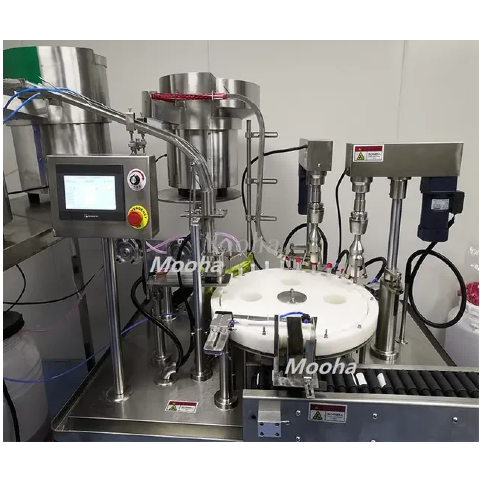
A vial filling machine is commonly used for small-volume liquids such as research reagents, oral liquids, perfume samples, air freshener liquids, and cell preservation solutions. Mooha’s systems typically support the 10 to 100 ml range, making them suitable for many small-format applications.
Because sensitive liquids may react to contamination or inaccurate dosing, precision and controlled sealing are essential.
Some buyers search specifically for a penicillin filling machine. In practical terms, this usually refers to a system designed to fill pharmaceutical vials with high standards of cleanliness and closure reliability.
While the core function remains accurate dosing into vials, pharmaceutical-style setups often emphasize stainless steel construction, easy sterilization, and stable sealing. Within this broader category, Mooha’s equipment can be configured to meet more demanding hygiene and structural requirements.
Production flexibility is a strong advantage. Companies frequently launch new products or adjust package sizes. A machine that allows quick parameter adjustment for different fill volumes supports both pilot production and multi-SKU manufacturing.
Export-oriented businesses may use glass vials in some markets and plastic vials in others. Equipment that accommodates both materials provides greater operational flexibility.
Reliable handling mechanisms help reduce breakage for glass vials while maintaining stable positioning for lighter plastic containers.
For hygiene-sensitive sectors, machine structure directly affects long-term reliability. Stainless steel surfaces are easier to clean and resist corrosion. Smooth design reduces residue accumulation, making maintenance more straightforward.
These features contribute to consistent performance over time, especially in environments with strict cleanliness expectations.
Stage | What Happens | Why It Matters | Buyer Benefit |
Vial feeding | Vials are aligned and moved into position | Prevents jams and misalignment | Smoother production |
Filling | Product is dosed into each vial | Controls accuracy | Less waste |
Stoppering | Inner closure is placed | Protects product | Lower contamination risk |
Capping / sealing | Outer closure is secured | Prevents leakage | Better package integrity |
Optional labeling | Product identification added | Improves traceability | Easier downstream handling |
This structured sequence shows that a vial filling machine does not operate as a simple liquid dispenser. It performs coordinated actions that directly influence final package quality.
Many companies begin with limited batch sizes. As demand increases, manual methods become inefficient. An automated vial filling machine supports gradual scaling without forcing a complete redesign of the production line.
For pilot runs, adjustable parameters allow small volumes to be produced efficiently. As orders grow, output can be increased by optimizing cycle time and workflow.
Shanghai Mooha integrates research, production, and sales under one system, focusing on filling and packaging machinery for liquids, powders, and other materials. The company’s experience in powder filling lines, granule filling lines, and liquid filling systems strengthens its understanding of dosing precision and packaging stability.
For vial applications, Mooha emphasizes customization. Vial size, product viscosity, and production speed can be adjusted to match specific needs. Rather than offering a rigid, one-size solution, the system can be configured to support unique packaging requirements.
This flexibility makes it suitable for pharmaceutical, cosmetic, biotech, and specialty chemical sectors seeking reliable small-volume packaging equipment.
A vial filling system does far more than simply dispense liquid into a container. It coordinates feeding, precise dosing, secure sealing, and consistent workflow to protect small-volume products and maintain packaging integrity. For businesses working with sensitive liquids or controlled-dose applications, integrating filling and capping into one stable process improves efficiency and reduces risk. If you are planning to upgrade your small-volume packaging line, contact Mooha to learn how a customized solution can support your production goals.
The main purpose of a vial filling machine is to accurately fill small containers with liquid or powder and apply secure closures to protect product quality. It improves consistency and reduces contamination risk compared with manual filling.
Yes. Many systems, including Mooha’s solutions, allow adjustable filling volumes and can be configured to accommodate different vial sizes within a certain range.
A penicillin filling machine usually refers to a pharmaceutical-oriented configuration of a vial filling machine. It emphasizes hygienic design, reliable sealing, and stable dosing suitable for medical applications.
An integrated vial filling capping machine combines filling and closure steps into one coordinated process. This reduces handling, improves production flow, and enhances package consistency.

