
English 


Views: 0 Author: Site Editor Publish Time: 2026-02-11 Origin: Site


In industries that handle powders, from food to pharmaceuticals, the precision and efficiency of packaging play a significant role in maintaining quality, reducing waste, and improving production speed. A powder filling machine is designed to handle the specific requirements of dispensing powders into containers with accuracy and consistency. These machines are essential for businesses in sectors like food, chemical, and pharmaceutical industries, where the smallest variation in quantity or contamination can lead to significant issues. At Mooha, we specialize in high-precision powder filling machines, ensuring your products are filled accurately, efficiently, and in compliance with industry standards.
A powder filling machine is a specialized piece of equipment used to dispense powder-based substances into containers with high precision. These machines are designed to fill containers such as bottles, jars, pouches, and vials, ensuring the exact quantity of powder is dispensed every time. In industries like food processing, pharmaceuticals, and chemicals, accuracy is paramount, and even the slightest discrepancy can affect product quality and customer satisfaction.
The functioning of powder filling machines depends on the type of machine and its specific use case. The basic operation typically involves loading powder into a hopper, which then moves through a metering mechanism (like an auger screw) to accurately dispense the powder into containers.
Powder filling machines help in automating the process of powder packaging, which significantly improves efficiency, minimizes human error, reduces product waste, and prevents contamination. These machines are widely used in high-volume production lines but are also available in semi-automatic versions for smaller batch operations.
Understanding the core components of a powder filling machine helps to appreciate how they achieve their precision and efficiency:
Hopper: This is the primary container where the powder is stored before being dispensed. The hopper is designed to ensure a steady flow of powder without clogging or spillage.
Auger Screw: The auger screw is the most crucial component in powder filling machines. It rotates to move the powder from the hopper and into the container. The screw mechanism ensures that the powder is dispensed with precision, and the amount is consistent.
Controls: These are used to monitor and adjust the amount of powder being dispensed. Modern powder filling machines come with digital controls, often integrated into a touchscreen interface, allowing operators to fine-tune the settings to match the required fill quantity.
Frame: The frame of the machine is the sturdy base that houses all components. It is designed to ensure the machine remains stable during operation and is capable of handling high-speed production processes.
A powder auger filler is a type of powder filling machine that uses a rotating screw (also known as an auger) to transport powder from the hopper to the container. This mechanism is widely used for filling powders that are fine or granular, such as flour, coffee powder, spices, or even chemicals like talcum powder. Auger fillers are particularly effective because they can handle powders with varying flow properties and are capable of delivering precise quantities, even for materials that are difficult to handle.
Auger fillers are also advantageous because they minimize waste. The design of the screw mechanism ensures that there is little spillage, reducing material loss and making the process more efficient. This makes them ideal for industries that need to minimize powder wastage, such as the pharmaceutical or food industries.
Powder filling machines are used across multiple industries, each with its unique requirements. Here are the key industries that rely on these machines:
The food industry is one of the largest users of powder filling machines, particularly for products like spices, flour, sugar, powdered drink mixes, and baking ingredients. These powders need to be accurately dispensed into small pouches or large containers. Auger fillers are popular in this sector due to their ability to handle fine powders without spillage or contamination. The machines ensure that every package contains the exact amount of product, helping businesses maintain consistency and avoid costly overfill situations.
Additionally, powder filling machines are crucial in maintaining hygiene standards within the food industry. These machines are designed with materials that are easy to clean, reducing the risk of contamination and ensuring that the products meet food safety regulations.
The pharmaceutical industry demands the highest level of accuracy and reliability, as any deviation in the quantity of ingredients can lead to serious health risks or violations of regulatory standards. Powder filling machines are used extensively to fill capsules, vials, and other pharmaceutical containers with powdered ingredients such as active pharmaceutical ingredients (APIs) or excipients. The precision of these machines is paramount in ensuring that the correct dose is delivered every time, making them indispensable in the pharmaceutical sector.
Pharmaceutical companies often require machines that meet stringent compliance requirements, such as Good Manufacturing Practices (GMP). Powder filling machines in this industry are designed to be easy to clean and maintain, with features that minimize contamination risks.
The chemical industry uses powder filling machines to handle various powdered substances, including fertilizers, detergents, and industrial-grade chemicals. These powders may vary in texture and flow properties, which means that a single solution may not be effective for all chemical products. Auger fillers are ideal for this industry, as they are capable of handling powders with poor flow characteristics. By using these machines, chemical companies can ensure that products are accurately filled into containers, from small pouches to large bulk bags.
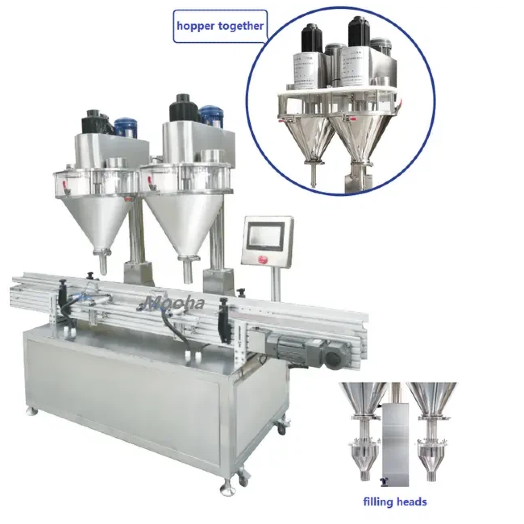
When considering which powder filling machine to purchase, it’s essential to choose between a semi-automatic or a fully automatic machine. Both types offer unique benefits, and the choice depends on the production scale, budget, and specific requirements of your business.
Semi-automatic machines are more affordable and easier to operate, making them ideal for businesses with moderate production volumes or for companies just starting out. With these machines, operators manually place containers under the filling nozzle. Once the container is in position, the machine automatically dispenses the powder into the container. This process is slower than fully automatic systems but still highly efficient for small to medium batch operations. Semi-automatic machines are often found in small businesses or for those working with a limited range of products.
Fully automatic machines, on the other hand, are designed for high-volume production lines. These machines are fully integrated with conveyor systems and automated controls, requiring little to no manual intervention. The entire process, from placing containers to filling and sealing, is handled automatically, making it ideal for businesses that need to process large quantities of powder quickly and efficiently. While the initial investment in fully automatic systems is higher, they provide greater efficiency, speed, and reduced labor costs in the long term.
Feature | Semi-Automatic | Automatic |
Operator involvement | Yes (manual placement) | No (auto conveyor) |
Suitable for | Small-medium batches | High volumes |
Cost | Lower | Higher |
Integration | Moderate | Full packaging line |
The powder filling process involves handling substances that are prone to creating dust, especially fine powders. Dust can be a significant issue in various industries, as it can lead to product contamination, loss of material, and environmental pollution. This is where the precision and dust control of powder filling machines come into play.
The auger screw mechanism, which is commonly used in these machines, offers superior precision for handling fine powders. It minimizes powder wastage and prevents excessive dust from being released into the air. The ability to control dust emissions is essential for maintaining a clean and safe working environment, particularly in pharmaceutical and food processing industries where contamination can affect product quality.
A key advantage of powder filling machines is their ability to keep dust at bay. These machines are often designed with enclosed systems that reduce the amount of powder escaping into the air during the filling process. Dust-free operation is not only crucial for maintaining cleanliness but also for meeting regulatory standards in industries like pharmaceuticals and food production. Reducing dust also contributes to safer working conditions by minimizing the risk of inhalation and environmental contamination.
Powder auger fillers offer many features that make them suitable for a wide range of industries:
Handling Free & Non-Free Flowing Powders: Auger fillers are ideal for both free-flowing powders, like coffee, and non-free-flowing powders, such as flour or pharmaceutical ingredients.
Repeatability: The auger screw ensures consistent filling, which is essential for businesses that need to maintain product uniformity and quality.
Speed Benefits: Auger fillers can operate at high speeds, making them perfect for high-volume production lines where efficiency is crucial.
In conclusion, powder filling machines are indispensable for businesses that deal with powders, ensuring accuracy, efficiency, and minimal waste. These machines help improve packaging quality and reduce operational costs, whether you’re working in the food, pharmaceutical, or chemical industries. By understanding the function of powder filling machines and the various options available, businesses can make informed decisions that enhance their production lines and maintain product integrity. For more information on how Mooha’s powder filling machines can improve your packaging operations, contact us today!
1. What makes auger fillers better for powder packaging?
Auger fillers provide precise, consistent dosing for fine powders, reducing waste and ensuring accurate packaging.
2. How do semi-automatic powder filling machines differ from fully automatic machines?
Semi-automatic machines require manual placement of containers, while fully automatic machines handle the entire filling process automatically, making them ideal for high-volume production.
3. Can powder filling machines be used for both small and large batches?
Yes, powder filling machines come in various models to suit both small-scale operations and large, high-volume production lines.
4. Why is dust control essential in powder filling processes?
Dust control is important to prevent contamination, ensure worker safety, and maintain a clean, efficient production environment.

